

The title of this post is one of the most common questions I get. The uncertainty surrounding decisions like this is one of the main reasons people hire me. They don’t want to get hurt, and they feel better outsourcing those decisions to someone who knows what to look for.
But not everyone can hire a trainer, so I thought it might help to explain what I look for when I decide to increase the weight on an exercise.
What I want to see before we increase weight
As much as I would love to say there is a standardized trigger for increasing weight, this decision has some nuance.
The most obvious answer is that you can do all of the prescribed reps for every set of an exercise. So, if you’re supposed to do 3 sets of back squats for 5 reps and you do all 15 reps, that’s where we can start having that conversation. But there’s more to it.
Was it hard?
Did you do all 15 reps without breaking a sweat, or did you plunge into the depths of hell and barely make it back out alive? That is why many coaches add a subjective measure of effort, like RPE (rate of perceived exertion) or RIR (reps in reserve)1. Both of these estimate how close you are to muscular failure. Closer to failure = harder; further from failure = easier.
So, if you could do all your sets with a relatively low RPE (or high RIR), you can probably safely increase the weight next time. If you saw God during an RPE 10 set, it’s probably best to stay where you are for now.
How was your technique?
I don’t think “perfect” technique exists, but technique still matters. I want to see that your reps are at least somewhat consistent, and you’re doing the exercise such that the right muscles are being used.
If you’re all over the place for every rep, I want to see that tightened up a little before going up. But even this is nuanced.
Without getting into the weeds, heavier weight can sometimes teach better technique. When the weight is light, your technique can be inefficient and inconsistent, and you’ll still probably be able to lift it. As the weight gets heavier, you’re forced to find a more efficient way to lift it, or you won’t be able to complete the reps.
That doesn’t mean we should keep increasing weight even with shaky form. It just means shaky form can sometimes be “cleaned up” by combining further learning with heavier weight that reinforces more efficient technique.
This is a judgment call, but I generally only move up if I think learning, not strength, is the bottleneck. I see this much more with new lifters. They’re strong enough to lift the weight; their limbs just seem to have a mind of their own right now. The weight is light enough for these folks that errant reps won’t become catastrophic mistakes.
How was your range of motion?
No matter how much research comes out extolling the benefits of things like lengthened partials, I will always default to wanting some approximation of full range of motion. That will look different for each person, because anatomy and mobility vary, and not everyone has the same ROM capacity.
I generally think someone should move through as full a range of motion as they can, as long as they’re not changing the purpose of the movement. In other words, as long as your squat is still doing what a squat is supposed to do, move through as much range of motion as you have available to you.
ROM creep is a thing. If I see a client increase the weight at the expense of range of motion, I will ask them to drop it. Similarly, you should hit whatever range-of-motion target you’ve set for yourself on every rep before deciding to increase the weight.
What to consider once you increase the weight
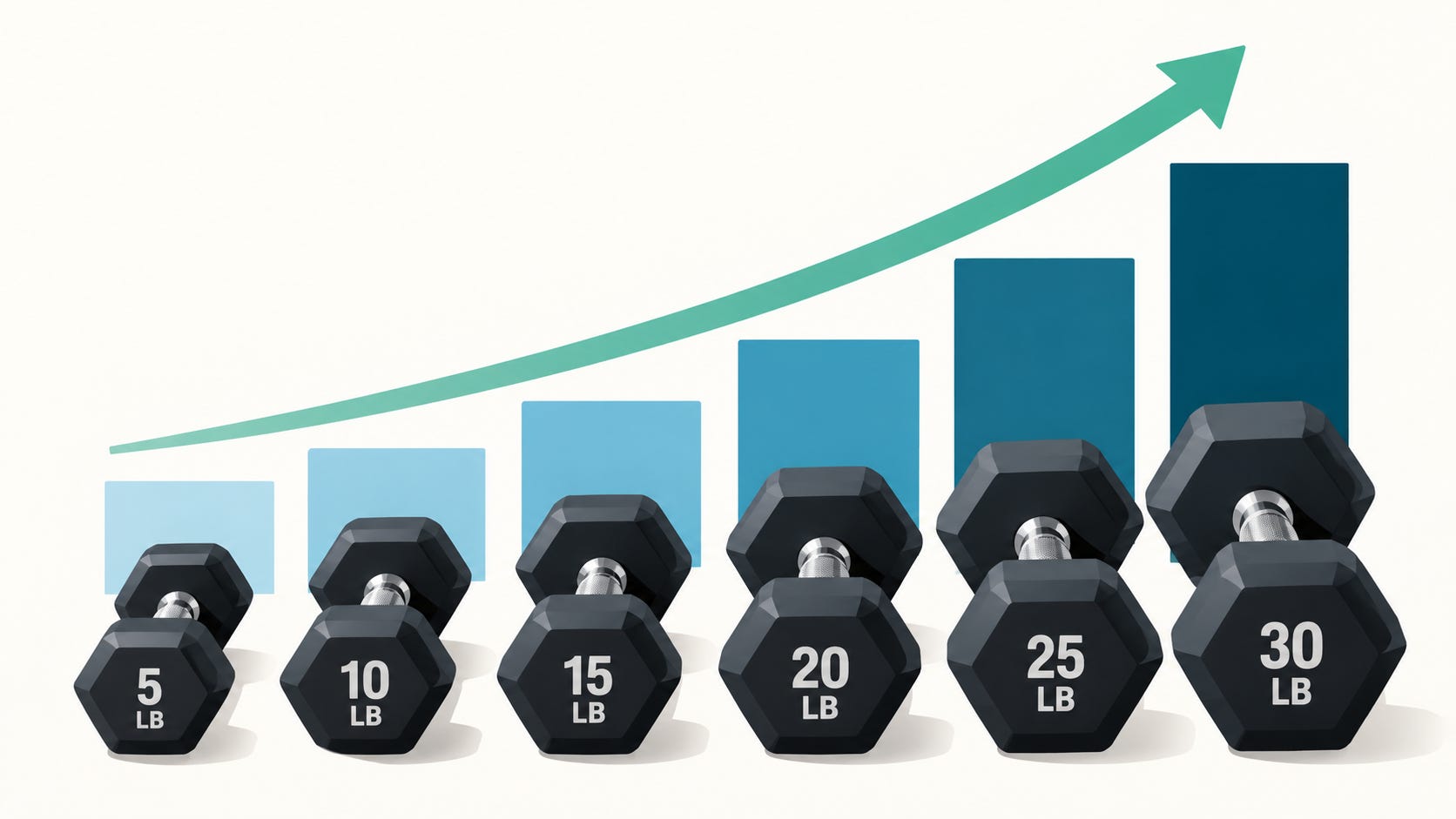
If you have a lot of room to move up on an exercise, it’s not a big deal to maintain the same reps after you move up. You do a set of bicep curls for 10 reps with 10lbs; you increase the weight and do another 10 reps with 15lbs. This is pretty common when you’re feeling an exercise out or when you’re still a beginner, and you’re seeing tangible strength increases from workout to workout.
But once you reach a certain point, it becomes difficult to maintain the same number of reps when you increase the weight. Which is why I typically deploy a double progression strategy, which I have talked about ad nauseam. If you need to drop the reps to “reach” the next weight, that’s perfectly fine. I view it as a “one step back to take two steps forward” system. If you drop the reps, you may be doing less overall work, but the goal is to build those reps back up until you’re eventually doing the same number you were doing before, only with heavier weight.
What might make me reconsider?
Most folks, after following the advice in this post, do just fine after a weight increase. But sometimes, I will increase the weight for a client and decide they aren’t quite ready for it. This happens for two reasons.
One, they may have been able to bang out rep after rep at a certain weight and then get completely folded with the slightest increase. Sometimes even a relatively small weight increase can cause a surprisingly large drop in performance, especially when that increase represents a substantial percentage jump.
In these instances, the heavier weight isn’t just harder; it crosses a threshold where they can barely lift it. I may still stick with it, but if they can’t do more than 3 reps or so with the new weight, I may have them increase reps at the lighter weight for a little longer before trying again.
The second reason, which is rarer still, is if someone’s form deviates so much from the preferred path that we may need to table the increase for a bit. Some variation is perfectly fine and part of the learning process, but if I feel an imminent threat of injury due to wild fluctuations in technique, I may wait.
This still isn’t the best solution, because if the goal is to get stronger or build muscle, you gotta move up sometime. To soften the increase, we can create even more distance between the reps done at the lighter weight and the reps done at the heavier weight. For example, we may be trying to go from 10 reps to 6, but we really need to go from 12 reps to 4. This sounds insane, and as I said, it’s very unusual, but if my goal is to reach the next weight “tier” with lower risk, I might try this.
Time off makes this trickier
I’ve shown you there is some nuance to this process, but it’s mostly a simple decision tree for figuring out when to increase weight. But one variable could blow this whole thing up: consistency. Without consistency, almost nothing works, and without it, progression is an absolute bitch.
For starters, you can’t even really rely on predictable progress even if you show up for every workout. But if you’re constantly missing workouts, you'll likely need to stay at the same weight, and if the time off is long enough, you may even have to drop weight.
So while you may have reached all the criteria for increasing weight—all the reps, relatively low RPE, full ROM—because you’ve given your body a chance to lose capacity, you probably shouldn’t move up in weight.
Bringing it all together
Hopefully, you now have a better understanding of when to increase the weight and how to make increases more manageable. We need to complete the reps with acceptable technique and manageable effort, and we need to be consistent with our training.
If weight increases feel particularly scary, you can drop the reps after moving up to recalibrate more safely. You will still have to exercise some judgment, but you got this. As long as you’re smart about progression (i.e., increasing incrementally), you’ll be fine.
RIR is reps in reserve, which represents how many more reps you could have done. An RIR of 0 indicates complete muscular failure, and an RIR of 2 means you could have done 2 more reps. RPE is often treated as the inverse of RIR on a 10-point scale. RPE 10 is RIR of 0, RPE 9 is RIR 1, etc.