

Aside from trainees neglecting one or more of the three pillars of resistance training, one of the next biggest mistakes I see beginners make is switching exercises too often. It could be due to program hopping, carryover from their participation in adult fitness classes, the desire to try out the latest and greatest from TikTok or Instagram fitness influencers, or simply an inclination toward novelty.
Variety can absolutely have its place in training. But if you want to see significant strength gains and muscle growth, you’re probably better off keeping your program mostly the same. Let me explain why.
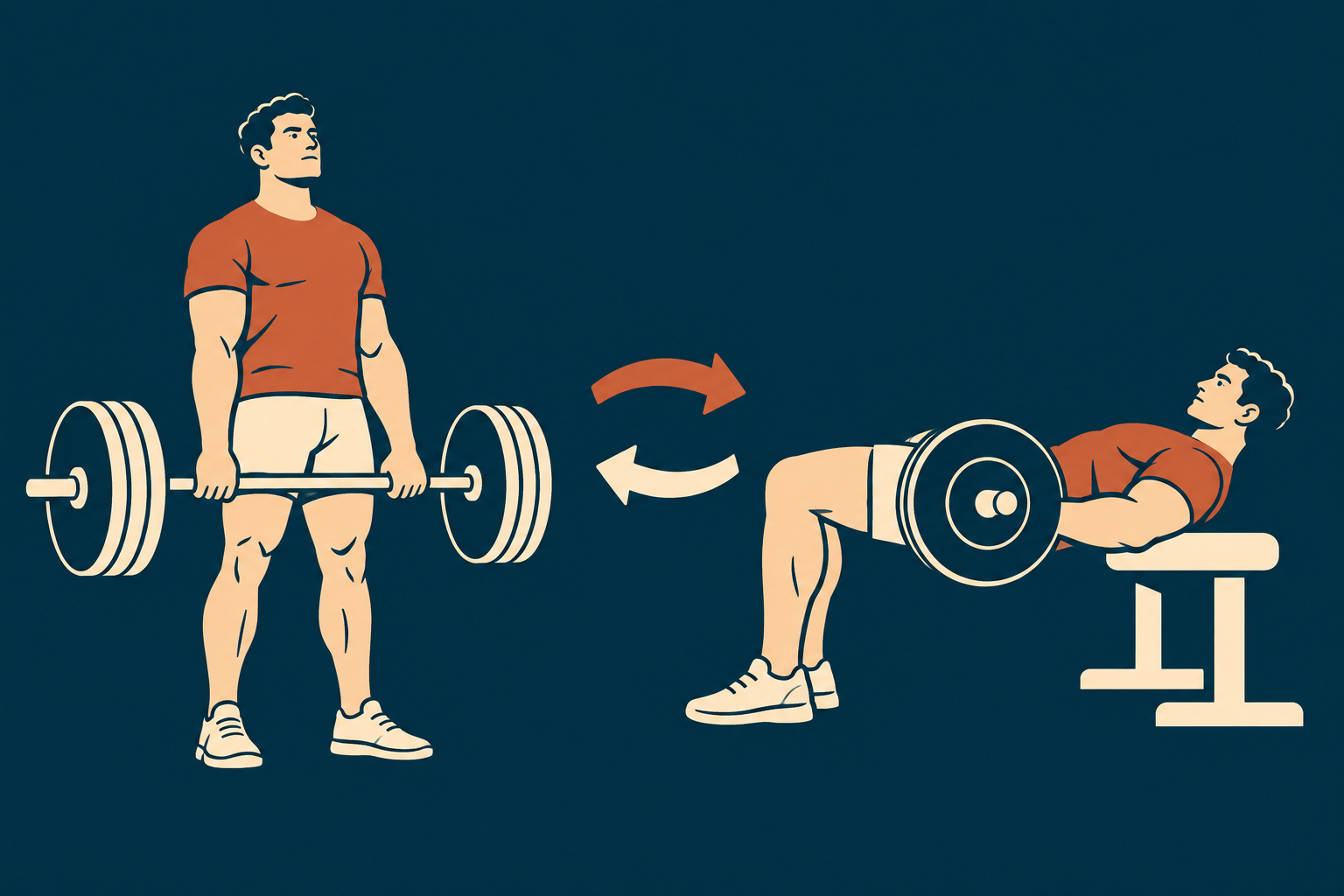
Why do we need to repeat exercises?
We need to get past the learning stage (i.e., build proficiency)
When you’re first learning a movement, you are relatively bad at it. For example, if you’re learning the bench press, the bar probably isn’t just moving up and down like it’s supposed to1; it’s likely also moving side to side and front to back. You’re probably also not hitting the right spot on your chest consistently if the bar is even hitting your chest at all. This inefficient version of the bench press produces a poorer stimulus than a more efficient version would at the same stage of training.
A lot of your early strength gains come from improving neuromuscular coordination rather than muscle growth. The more dialed in your technique is, the harder you can push the exercise and the more precise the stimulus is in targeting the right muscles. The key drawback of frequent exercise-switching is that you are spending valuable training time getting reacquainted with the lift instead of pushing with higher effort.
We need to compare apples to apples
Building strength and muscle requires progress over time, whether that’s more weight with the same reps, more reps with the same weight, or the same work at a lower effort. In order to know where to go, you need your history with the movement to inform that progress.
Using the same movement allows you to easily assess and facilitate progress. You’re comparing apples to apples each week. But unless your superpower is precisely knowing the “exchange rate” between exercises—and what a terrible superpower that would be—it’s more difficult to gauge (and take advantage of) progress when you’re doing different exercises week to week. Every time you switch exercises, you won’t know exactly where to pick up, and more broadly, you will have a harder time figuring out what strength progress you’ve actually made.
That doesn’t mean you should never switch exercises, but rather that switching excessively may be counterproductive to your goals.
So let’s look at when switching things might be more appropriate.
When should you switch exercises?
When you are no longer making progress
If your goal is to build strength and muscle, my simplest advice for when to switch an exercise is when you’re no longer making progress. And I don’t mean you’ve gone two weeks in a row with no change. I mean when you’ve made significant gains on an exercise over a long period, you’re doing all of the outside stuff well—eating enough, getting enough sleep, and training consistently—and you have hit a wall for weeks or months.
Slow gains are not no gains, and it’s ridiculous to expect newbie gains indefinitely. As with anything else, there are diminishing returns. Most of the progress happens when you first start training, and then progressing every workout becomes every other workout, every few workouts, once a month, or even slower.
When you reach the point where you cannot seem to make progress when you’re doing everything right over a long time period, it may be time for a change. But I will be real with you. Almost no one will hit this point for any compound exercise in their training. The runway for most compound lifts is long. We’re talking years for most people.
So it’s fair to say this won’t be the reason most people should switch things up. So what is?
When further progress costs too much
I like deadlifts and often put them in my clients’ programs. It’s relatively easy for me to get to 405 pounds or so, but as soon as I start pushing to 500, little aches and pains start popping up like clockwork. The strength is there, but my body, particularly my hips, just hates the journey.
With some lifts, you may reach a point where pushing for more progress starts to cost you a lot more in fatigue or aches and pains.
So it’s not that you can’t keep progressing this exercise, but that the input-to-output ratio starts to rise sharply and the juice is honestly just not worth the squeeze.
We’ve covered the reasons for highly motivated and committed trainees looking to build strength and muscle, but that’s not everyone or even most people. Gen pop folks may have an even earlier trigger for change.
Motivation is hanging on by a thread and variety is your lifeline
If you want to get a little stronger, look a little better, and be healthier, you may not get excited about doing the same thing over and over again in the gym. I get it.
I will always push people to go to the gym and exercise in whatever way impels them best. And for some, that may be fitness classes, consistently shifting focuses, or learning new things. There’s a huge market for that type of trainee.
As much as I want to superimpose my own goals onto my clients, most of them have far less interest in optimizing their training for strength or muscle growth than I do. For these clients, a reduction in optimization in exchange for increased novelty is worth it.
If novelty is the single thing that drives you in the gym, then that’s exactly what you need. That said, I would urge you, as I have done for my clients, to maintain some consistency so you can make slightly better progress. Here are some ways you could do that:
Keep one to two lifts the same for at least a few months and feel free to change any of the others.
Use variations that are relatively close to each other so the exchange rate is high.
Focus the novelty on isolation exercises with shorter runways (i.e., you can’t progress them for nearly as long as compounds).
Use always novel finishers at the end of each workout.
There are many different ways you can add variety while also maintaining some constancy in your workouts. But if you’re driven largely by things constantly changing, do it! It’s far better than not training at all.
I saved the best for last as it’s probably the most common reason I change exercises outside of stalling progress and increased injury risk.
When we have discovered a better alternative or just want to change course
Every once in a while, I will realize that I’ve chosen an exercise that’s just a poor fit for my goals. Maybe it’s a bicep curl exercise where I can’t feel my biceps very well, a leg exercise that seems to target everything but my quads, or a variation that I just fucking hate.
If something isn’t working, there’s nothing noble in continuing to charge forward. It’s perfectly fine to recognize an exercise just isn’t working for you anymore. It’s just as important to find exercises that are a good fit as it is to stay the course once you’ve found them. As I mentioned a couple weeks ago, we don’t need to make our workouts suck any more than they have to.
As long as you’re being honest, and it’s not just a thinly veiled excuse to satisfy your novelty-seeking behavior, gotta find what works!
The Nuance
My philosophy has always been to keep exercises in my program until I stop making progress, the risk/reward ratio gets too high, or the exercise is no longer serving me.
But not everyone is like me, and there will always be a need to optimize for consistency. If you’re the kind of person that desperately craves more variety, switch things around to your heart’s content. As long as you know what the tradeoffs are and you’re happy with the results, who the hell am I to discourage you?
The bar doesn’t technically just move up and down in a bench press. That would have the bar landing too high at the bottom. Instead, the bar travels slightly diagonally toward the feet to hit lower on the chest.