

There is a lot of money in selling women the idea that they are different from men. So different, in fact, that they require an entirely different training protocol and considerations if they want any results in the gym. And many grifters in the women’s fitness and health space use this to their advantage.
There are two questions to answer here:
Do women respond differently to training?
Are there considerations unique to women as a group that require them to train differently?
My answer to both is a resounding no, but the nuance is important here.
Do men and women respond differently to training in general?
When most people look at men and women, they assume, based on size and strength differences, that men must respond better to training. But that’s not really true and almost all of those differences come from outside of the gym.
Men tend to be more muscular for two reasons: one is biological and one is social. Higher levels of testosterone give men a higher muscular floor, which means men start with more muscle and have more muscle than women even if they don’t work out.
There is also societal pressure on women to look more “feminine” and less “bulky”, which may lead to women choosing forms of resistance training or training in ways that aren’t great at building muscle. If you want some good examples, look at most of the fitness classes geared toward women—Pilates, barre, Lagree, “sculpting” and “toning”, or dance-based classes. There is absolutely nothing wrong with these classes, but it’s obvious that their chief concern is not optimizing strength or muscle growth. They often use light weights, have a very small runway for progression, and many stay far away from muscular failure.
If women spent more time “training like men”—heavier compound lifts, taking sets closer to failure, and progressing exercises over time—they would likely find that they are able to gain muscle and strength at a similar relative rate to men.1
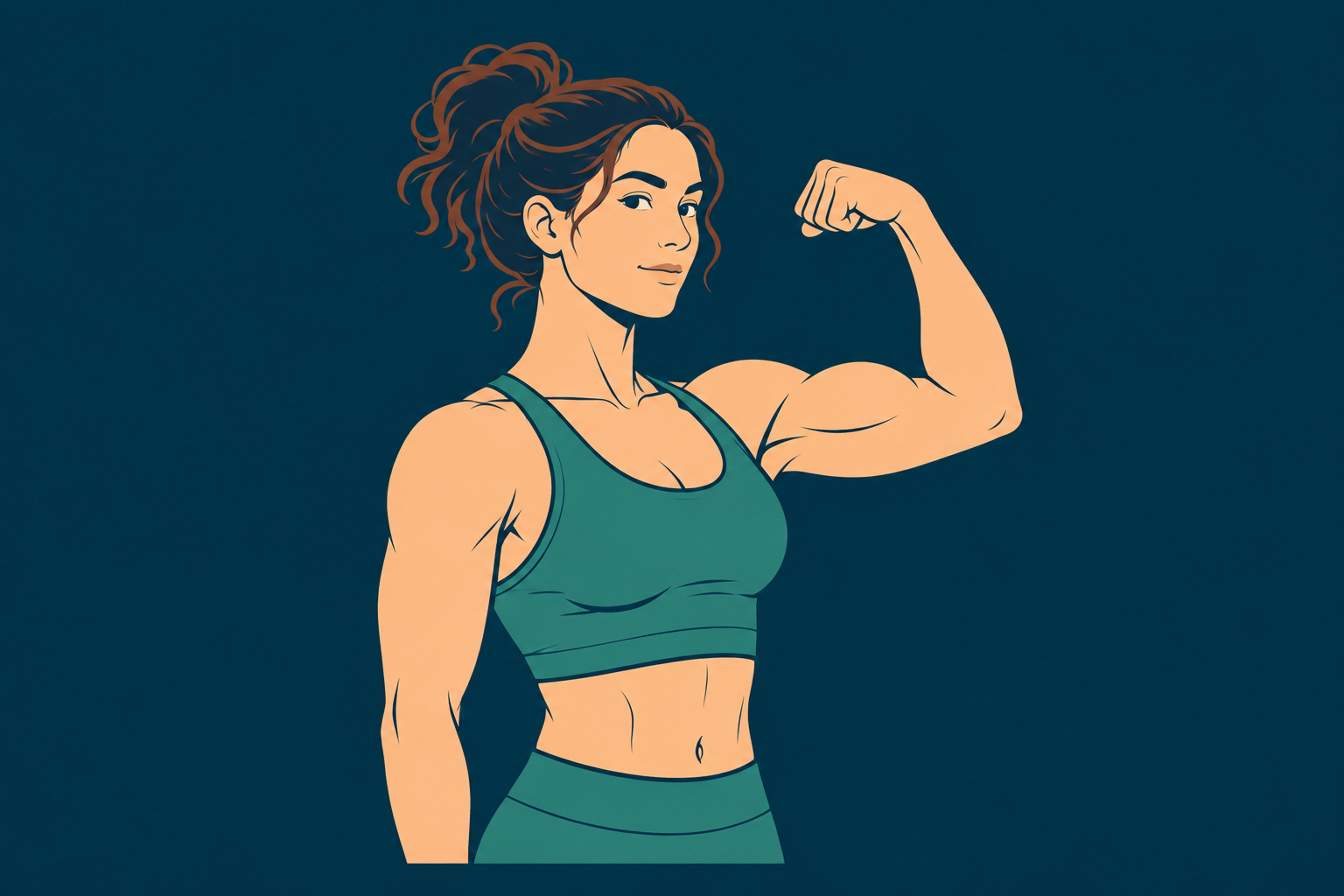
“Women respond differently based on where they are in their cycle”
Menstrual cycle periodization, or “cycle syncing”, as an idea has been knocking around for decades. Alisa Vitti is probably most credited for commercializing it back in 2013, when she created her proprietary framework The Cycle Syncing Method, but that framework is informed by research that was conducted almost twenty years prior.
Cycle syncing is, in essence, the idea that women should tailor training, nutrition, and other lifestyle behaviors to specific phases of their menstrual cycle to optimize outcomes.
Here are the typical recommendations for someone wanting to implement this in their training:
Menstrual phase: Rest or low-intensity exercise.
Follicular phase: Progressively increase training intensity and volume.
Ovulatory phase: Prioritize high-intensity exercise and heavy resistance training.
Luteal phase: Reduce training intensity and emphasize recovery.
I want to make it clear that I am not recommending this; it’s just the typical recommendation for implementing cycle syncing.
One of the earliest studies on cycle-based lifting was published by Reis et al. in 1995. This is an excerpt from the abstract:
Despite a wide interindividual variability, all subjects showed higher strength adaptations by MCTT (menstrual cycle-triggered training). Additionally, we found significant correlations between different force parameters and the accumulation of estradiol. It was concluded that the MCTT seems to be more efficient compared to RT (regular training).
Although promising, this is hardly enough evidence to plan your entire program around your cycle. Seven women doing one quad-training protocol is a thin basis for telling women how to train all month.
Two other studies also reported benefits from timing workouts around the menstrual cycle.2 The training recommendations went well beyond what these studies found, and all three studies had serious flaws. In one study (Sung et al., 2014), the researchers couldn’t even reliably tell when the women ovulated.
Lauren Colenso-Semple et al. highlighted those flaws in this 2023 umbrella review. And this 2026 randomized controlled trial added another nail in the coffin of cycle syncing when, after matching for total training volume, researchers found no extra strength or muscle gains from clustering sets in either phase versus distributing volume evenly across the cycle.
But this particular movement has legs, because it is very marketable. Hell, even Garmin is getting in on it. Its blog suggests different workouts for different phases of your cycle, and that kind of advice is showing up on its watches, too. Hormones fluctuate, sure. But where’s the evidence that planning your workouts around those fluctuations gets you better results?
Do women need to train differently because they are women?
There are two questions that get conflated when discussing the topic of cycle syncing:
Do women need to match their training to some prototypical menstrual cycle or adjust their training protocol specifically because they are women?
Might women need to modify training variables based on female-specific symptoms that can affect training?
The first one has no evidentiary support while the second is an emphatic yes. Let me explain how these are different.
The individual vs the group
Many women who argue in favor of menstrual cycle periodization believe they are arguing for any menstrual-cycle-based training modifications, but that’s not really what cycle syncing is.
Women are not all the same. In fact, variability among women is enormous. Trying to create blanket recommendations for what women should be doing at any given phase of their menstrual cycle completely ignores that:
Women do not have the same cycle length.
Women do not have the same symptoms across their cycle.
Women have different psychological responses to symptoms.
Women may need to adjust training based on their menstrual cycle symptoms, but that doesn’t mean women as a whole should preemptively schedule training around some theoretical menstrual cycle. I am for the former (this is just autoregulation); I am not for the latter.
Practical Considerations
There’s also a practical problem with planning your workouts around your cycle.
If you’re a woman and you’re setting out to start resistance training, the absolute last thing you need is more complication. Even if structuring your training plan to align with your cycle showed some benefits, those benefits would need to be significant to offset what a colossal pain in the ass cycle syncing is to implement.
Rather than having a simple program that’s mostly the same across the month, showing up, and doing what you can on any particular day, you now have to consider where you are in your cycle and what exercise modalities are conducive to the best performance or adaptations in that particular phase. No one wants to do that shit. So the evidence would have to be pretty compelling for me to even consider something like this. And it’s just not.
And in my opinion, there is nothing empowering about telling women they can’t perform well in certain phases of their cycle because of their hormones. It’s similar to telling people they can’t work out or their performance will suck because they didn’t get enough sleep. You don’t know that, and it can create a nocebo effect that can affect training. Hormones may be a factor but they affect each woman differently and they should be considered as part of the overall myriad of inputs that affect day-to-day performance—like sleep, stress, recovery, and nutrition. They are not some overarching controlling force.
My advice for women: having preferences is perfectly fine but don’t believe the notion that being a woman means you need to meticulously craft your workout routine around your hormones. Use autoregulation by adjusting training based on symptoms and how you feel. Not what your watch tells you and certainly not what some women’s health grifter is telling you.
Relative rate changes refer to percentage differences. A woman going from 100 lbs in a lift to 120 lbs is the same as a man going from 200 lbs to 240 lbs. Both lifters improved by 20%.
Sung E, Han A, Hinrichs T, Vorgerd M, Manchado C, Platen P. Effects of follicular versus luteal phase-based strength training in young women. Springerplus. 2014 Nov 11;3:668. doi: 10.1186/2193-1801-3-668. PMID: 25485203; PMCID: PMC4236309.
Wikström-Frisén L, Boraxbekk CJ, Henriksson-Larsén K. Effects on power, strength and lean body mass of menstrual/oral contraceptive cycle based resistance training. J Sports Med Phys Fitness. 2017 Jan-Feb;57(1-2):43-52. doi: 10.23736/S0022-4707.16.05848-5. Epub 2015 Nov 11. PMID: 26558833.