

As a professional in any field, if you’re not ever looking back on what you used to believe and cringing, you’re probably not growing much. In the future, there’s a good chance I will look back on something I believe now and think it’s stupid.
This is ultimately a good thing, though. It’s how learning works. I’ve been through several “phases” over my sixteen-year career, and in each one I gain a greater understanding of how everything fits together.
These are some of the biggest things I’ve changed my mind on in my career:
Fitness isn’t that complex
There are a bunch of different versions of this meme floating around, but this one most closely approximates my feelings toward the people that overcomplicate the shit out of training.
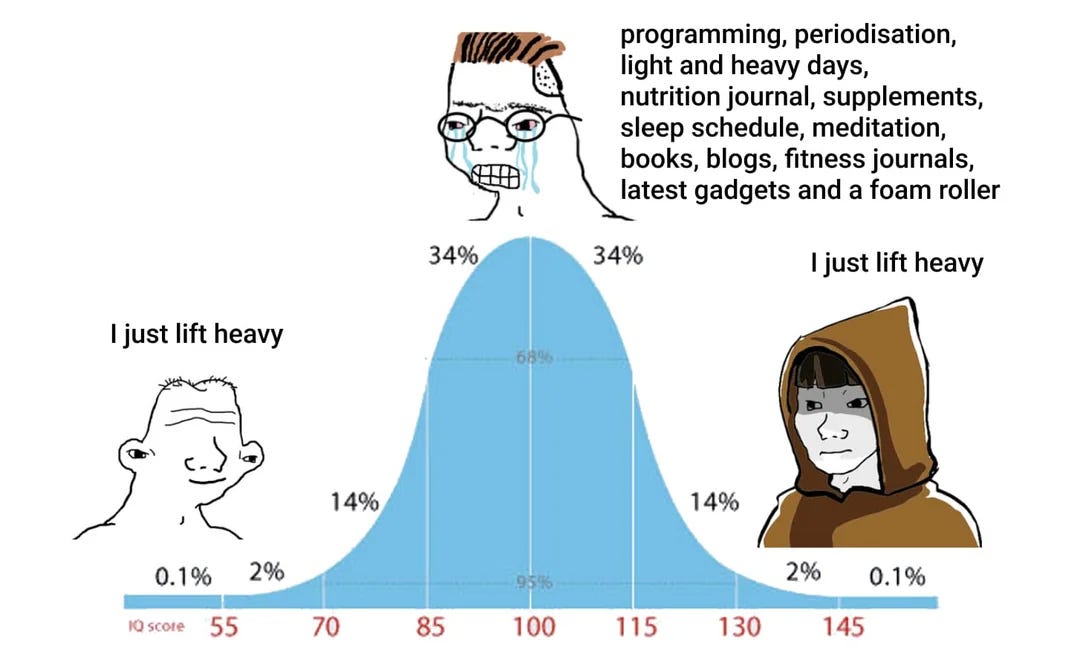
This is obviously slightly oversimplified, but it serves as a good reminder that when you go down the rabbit hole of a new hobby, you can get inundated with information that doesn’t matter all that much for 99.99% of people.
Right out of college, I genuinely believed every client I had would need a carefully periodized program with perfectly selected exercises all recorded in a sophisticated Excel spreadsheet. I needed a perfect biomechanical understanding of each exercise to give my clients the best possible results.
I wanted to know the best way to do everything. How many days of training? What time of day is the most effective? Which programming split and rep scheme was best?
All my careful planning got destroyed by reality. Clients would miss days and have preferences that didn’t align with what was best on paper. And none of them seemed interested in optimizing anything.
Building rapport with clients, making them feel comfortable and heard, and ultimately making them want to keep showing up mattered far more than the specifics of the program.
What actually matters for results also just isn’t that complicated.
The three pillars of resistance training are my attempt to distill weight training to its most basic elements. Just three things. Consistency, effort, and progressive overload. If you have those three things, you’re doing great. Don’t get bogged down in all the other shit.
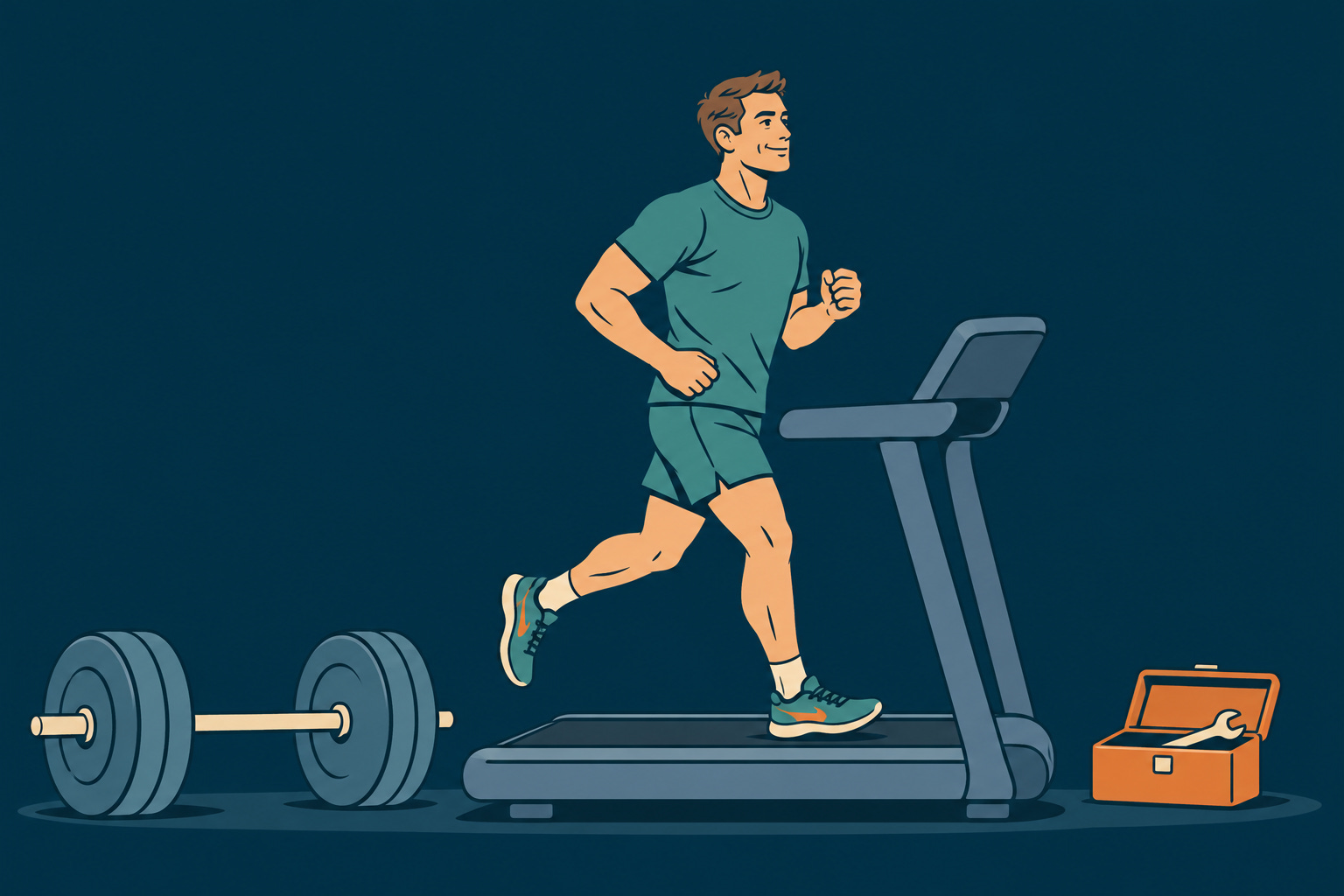
Do cardio, stupid
I didn’t do cardio for like fifteen years. At least not consistently. I had always been able to run two to three miles without issue despite never doing cardio. I thought this meant I didn’t really need it, but that was really just cope because I was a lazy bastard.
I convinced myself that cardio would interfere with my gains, that it did nothing for my body composition or physique, and that I had it mostly covered with intense resistance training sessions.
Dead wrong on all three counts.
Cardio has pretty limited interference with resistance training for the average person. I’ve been able to maintain almost all of my muscle and most of my strength while training for several half marathons and a marathon. I’ll admit I did find it tricky to balance both, but that stemmed mostly from running out of hours in the day and the fatigue from the increase in running volume. Not that cardio was creating some kind of physiological barrier to building muscle.
While I certainly wouldn’t make cardio my primary strategy for weight loss, it’s not inconsequential either. All else equal, introducing cardio can raise your total daily energy expenditure. Your body does adapt, however, which means energy expenditure may be less than you expect. But the addition of cardio to lifting, regular movement, and better nutrition choices is a phenomenal multi-pronged approach to weight loss.
My biggest mistake as a meathead was believing that cardio didn’t provide unique benefits beyond resistance training. The truth is that nothing trains your heart like cardiovascular exercise. That’s what cardio means. Heart.
Resistance training may raise your heart rate for short bursts, but it cannot hold a candle to the sustained increase in oxygen demand and delivery you get with cardio. Your VO2 max, cardiovascular and metabolic health, fatigue resistance, and ability to recover between sets and between workouts can all improve with cardiovascular exercise.
Resistance training is fantastic, but a well-rounded exercise routine needs cardio.
You don’t need to diagnose every tiny little ache and pain
For the people who are really into viewing their body the way a mechanic views a car, this is a hard pill to swallow. These folks always want to pop the hood and see what’s going on when they get injured or experience pain.
Their hips are rotated, one leg is longer than the other, they can’t activate their left glute, and their right lat is tight.
I have been this person. I know how frustrating it is to get injured and to be in pain and to want to know why. This is especially common for neurotic and analytical types. I know, because I am both.
These folks think if they can just get all the parts moving as they’re supposed to, they will reach some place of biomechanical and physiological nirvana where nothing breaks down and everything works like a well-oiled machine.
That way lies madness.
Pain and injury are often far too complex to be “solved” in this way. It would take a truly incredible knowledge of anatomy, biomechanics, and pain to be able to accurately identify and “fix” issues this way.
Anatomy and biomechanics are complex enough, but pain is a totally different beast. It’s not part of some infallible messaging system that relays perfectly accurate information about what’s going on in the body at all times.
It can go haywire. It can get amplified by non-physical variables, can ebb and flow for apparently no reason, and often has a very tenuous relationship with physical injury or dysfunction. It is an unreliable narrator.
I have already written an article about how I deal with pain and injury, but in simple terms, you don’t always need to know exactly what’s going on to move forward.
You do what you need to do to calm down the pissed-off tissue, find a pain-free entry point, and slowly build your way back up (monitoring the pain the whole time). Then you keep strengthening and desensitizing the tissue. Eventually you will be back to some version of normal again and will (hopefully) be wiser from your mistake.
This is how I have handled every single injury I’ve had. Refer out if the pain is intense and persistent, but otherwise, let your body do what it does best.
The Takeaways
Don’t get bogged down in extraneous detail. Fitness isn’t that complicated. Easy, no, but not complicated.
Show up, train hard, do more over time.
Also, do cardio; it’s good for you.
And lastly, fight the urge to meticulously search for the why behind every ache or pain. Keep doing what you can how you can while your body heals.
If you can learn from my mistakes, you will be far ahead of the majority of gymgoers. Godspeed.