

At this point, most people know how important consistency is for accomplishing anything. They know they need to show up. But knowing isn’t doing. There are two key axioms that I think can dramatically improve your mental approach to training: you do not need to feel good to work out and the more things you allow to keep you out of the gym, the less consistently you’ll train. Not the most elegant axioms, but I’m still workshopping them.
The point is if you only ever work out under ideal conditions, you won’t work out very much. The key isn’t necessarily to white-knuckle your workouts in all conditions—although there is an element of that you need to do—but to learn to be flexible with what you do in the gym on days when you’re not feeling your best.
The question shouldn’t be, “Am I going to the gym today?”; it should be, “What am I going to do in the gym today?”
Enough of that. Let’s talk about different scenarios where you may not feel like going to the gym and how to think about them.
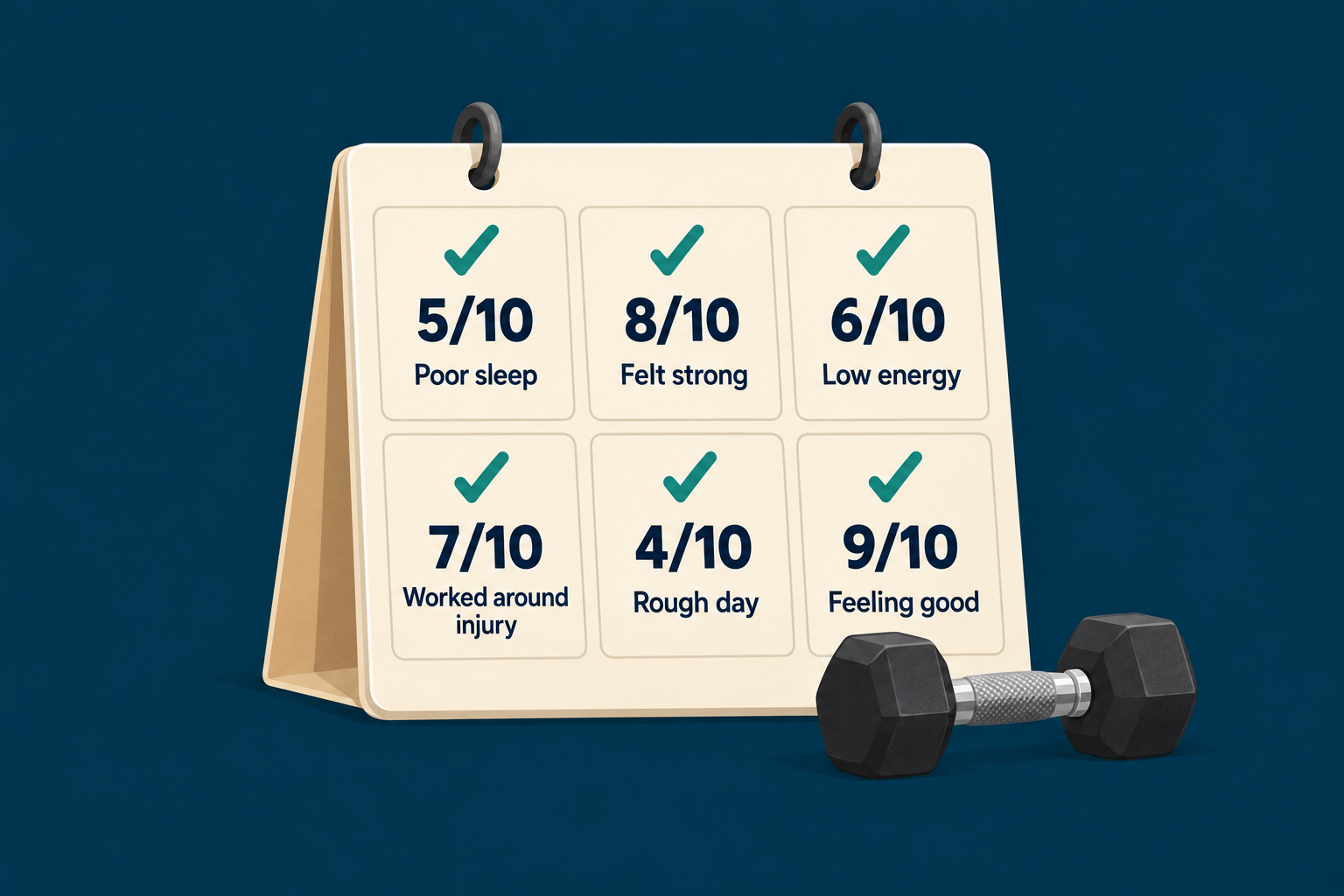
Training on poor sleep
The relationship between sleep and workout performance is not as tight as people think it is, but sleep absolutely matters. It’s difficult to determine what your workout will be like after a night of shitty sleep. I’ve hit PRs on three hours of sleep and had the strength of a weak toddler on 8 or 9 hours. You just don’t know, which is why I push clients to show up even if their sleep sucks.
I saw an interview once with Jordan Feigenbaum from Barbell Medicine that has stuck with me for years. Someone asked him a question about training while sleep deprived and if it was a good idea. Jordan said something like, “What are you gonna do, not train?” It was such a simple response that has had a profound impact on the way I think about training in imperfect conditions. In his case, he presumably maintained some kind of training schedule while going through residency where he was working ungodly hours and sleeping very little.
Of course getting perfect sleep is always the goal, but how many of us can get that consistently? I have a client who travels frequently and has three very young children, so sleep is a luxury for him. He has come into sessions on one to three hours of sleep multiple times and has never once canceled a session due to lack of sleep. We may pick a workout that has easier exercises, drop the weight on some of them, or cut a set across all exercises to match his energy or lack thereof.
When you’re tired, you have two options. You can either use that as an excuse not to work out or you can accept your fate, suck it up, and get to the gym anyway. I couldn’t tell you a time when I felt worse after working out on little sleep, and research even suggests that regular exercise may partially offset some of the long-term health risks associated with chronically poor sleep.
Go to the gym if you’re tired as fuck. You don’t need to have your A game to get in a good workout. Just go and do what you can. You’ll find that’s a recurring theme in this article.
Training with an injury
Clients skipping workouts (or attempting to skip workouts) when a relatively small part of their body is injured will forever be the bane of my existence. Unless you are truly debilitated, and thus cannot get to the gym, there are few non-catastrophic injuries that should prevent you from doing something.
If you have an upper body injury, train your fucking legs. If you have a leg injury, congratulations, you get to do what every guy secretly wants to do in the gym: exclusively train his upper body. “Oh no, I guess I can’t do legs. Might as well become a titan up top!”
At the end of the day, the goal is to interrupt training as little as possible. To do that, we simply need to avoid exercises, movements, ranges of motion, loads, and volumes that piss off the injured area. But do something for Christ’s sake.
Training while injured does three really important things:
It improves your self-efficacy—your belief in your ability to overcome challenges. Getting injured in the gym is part of the deal. You can’t push at the boundaries of your capacity and expect to remain unscathed. You will make mistakes. Better to improve your physical and mental resilience than expect injuries not to happen.
It facilitates recovery. You don’t heal faster by sitting on your ass. In fact, the opposite is true. Continuing to work around the injury is great for physical and mental recovery.
It maintains momentum. Missing workouts means losing progress to some degree and the more you miss, the harder it is to get back to it. Showing up while injured says, “Even when I have setbacks, I’m going to continue to do this thing because it’s important.”
Training when sick
Of all the variables that are most likely to keep me out of the gym, being sick is probably at the top. Not necessarily because I think it would leave me physically worse off but because bringing your contagion into a space where everyone is touching shit is kind of uncool.
There is some nuance here, though. If you’re deep in the throes of your sickness and knocking back every drug under the sun to remain human, you probably shouldn’t come to the gym.
But I don’t love when folks have the worst behind them and preemptively cancel training sessions days away. The truth is you don’t really know how you’ll feel or what condition you’ll be in. And if your illness is firmly in your rearview mirror—to the point where contagiousness is unlikely—missing more of a thing that will likely improve your mood and physiological state seems silly to me.
Again, you don’t need your best performance here. You may need to drop the intensity or volume, increase rest, whatever. That’s fine. It beats continuing not to work out because you’re being overly cautious.
Training when you’re in a bad headspace
I know this may surprise you, but I’m not always full of unbridled happiness every moment of my existence, and I am a naturally anxious person. There are days when the dark cloud hanging over my head tries to prevent me from going to the gym. I won’t lie to you and tell you that going to the gym is easy on these days or even that it will improve your headspace one hundred percent of the time. But in my experience, it won’t make you feel worse.
Regardless, I won’t tell you there is never an excuse to miss the gym for mental health reasons. But we also have a mountain of data demonstrating that exercise is pretty great for managing anxiety and depression.1 With virtually no downside, that seems like a pretty great benefit/risk ratio.
Conclusion
It’s not always easy to know when something is “cancel-worthy,” but you do need a high threshold for missing workouts. If a stiff breeze is enough to have you canceling your sessions, you’re probably never gonna look like you lift. The one trait that my most successful clients all have is that they do not miss workouts. And for that to happen, you need to prioritize the hell out of them. Other people do not care about your workouts, so you have to.
And the point of having a high threshold for missing training isn’t just for consistency; it’s so when you invariably do need to miss a session, you can do so guilt-free. Shit happens, but it needs to be legitimate shit to keep you away from the gym.
As always, thanks for reading.
Exercising in a group and supervised settings seems to be particularly effective, presumably because of the social aspects, greater adherence, more support, etc. The paper also found: “Exercise of shorter duration and at lower intensity was most strongly associated with anxiety reduction.” Because exercise is a stressor, there are likely diminishing returns beyond a certain point, after which the additional stress likely reduces some of its positive impact.